Best way to deal with needing to separate clothes by colour for laundry… have an all-dark wardrobe.
A isFavorite: Bool is the most violent compression anyone's ever done to a feeling. "I loved that shot of espresso on a rainy Tuesday when the grind finally clicked" gets crushed down to a single byte. The heart icon is a one-byte shrine to a memory it can't actually hold.
The sad, nerdy part is that we know one byte is nowhere near enough to be true, and we also know it's exactly enough to be useful. So we ship it. A real model of why you loved something can't be computed, and even if it could, nobody's tapping through twelve screens to log it. A faithful record of the feeling is useless. A sliver of a truth you can query is gold. That's what a favorite button really is. A quiet admission that we'd rather keep a searchable lie than an unsearchable truth.
And that's most of data modeling, honestly. The question is never "how do we represent reality?" It's "how much of reality can we throw away before the query stops coming back?"
PS: A Bool is represented using a byte in most languages as opposed to a bit because the CPU can't directly address a bit.
Amdahl's Law says the speedup you get from throwing more workers at a problem is capped by the part that can't be split. You can run a thousand agents in parallel and still sit there waiting on the one commit that has to happen in order. It's the same as a company hiring a thousand engineers and still grinding to a halt because one person/team understands the deploy script.
Parallelism doesn't kill the bottleneck. It just clears everything else out of the way until the bottleneck is the only thing left standing, lit up, impossible to ignore. The more you speed up the easy parts, the more obvious it gets that the slow part was always the drag.
Most of what we call "scaling" is just elaborate work to avoid looking straight at the one step we never wanted to deal with. We'll automate, distribute, and optimize around it forever, because that feels like progress, and staring at the actual problem doesn't.
Solving and optimizing for that is the real efficiency-unlock.
Philosophers spent two thousand years on the Ship of Theseus: replace every plank one by one, is it still the same ship? A programmer heard the question, ran the planks through a hash function, and said "no, it's a different ship, here's the receipt, can we go to lunch."
Turns out the riddle was only hard because everyone insisted the answer had to be profound. Ask "the same in what sense, and who's asking" and it stops being philosophy and becomes inventory.
The latest washing machines and dryers have AI sensing, moisture detection with material type care, heat pumps for energy efficiency, and many other advanced features.
All I want (have wanted since I was a kid) is to have clear peek-in doors, illumination, and/or a camera that shows what’s happening inside.
That’s the simplest thing they could add, and boom! It’s now an entertainment/meditation appliance, not just utilitarian.
Same applies to dish washers.
A wise friend said some very relatable words to me today.
Start with the concrete and move to the abstract.
Looking back, most of my life, all the things I've gotten good at and have earned me experience, wealth, and command have happened this way. Get deep into something and understand it in multiple layers with nuance (concrete). Then, move out, and see and use that as part of a larger system (abstract).
Works really well! After a few times, learning anything and having a command over the minutia of a larger system feels extremely natural and first-nature.
🐥
I’ve landed on a simple rule. Generative models handle the mundanity in my life: whatever bores me.
If the task needs my mind, my mind does it. That’s my guardrail against a certain quiet atrophy.
The creative, exciting, emotional, problem-solving parts are worth keeping for myself. That’s the human experience I won’t give up on.
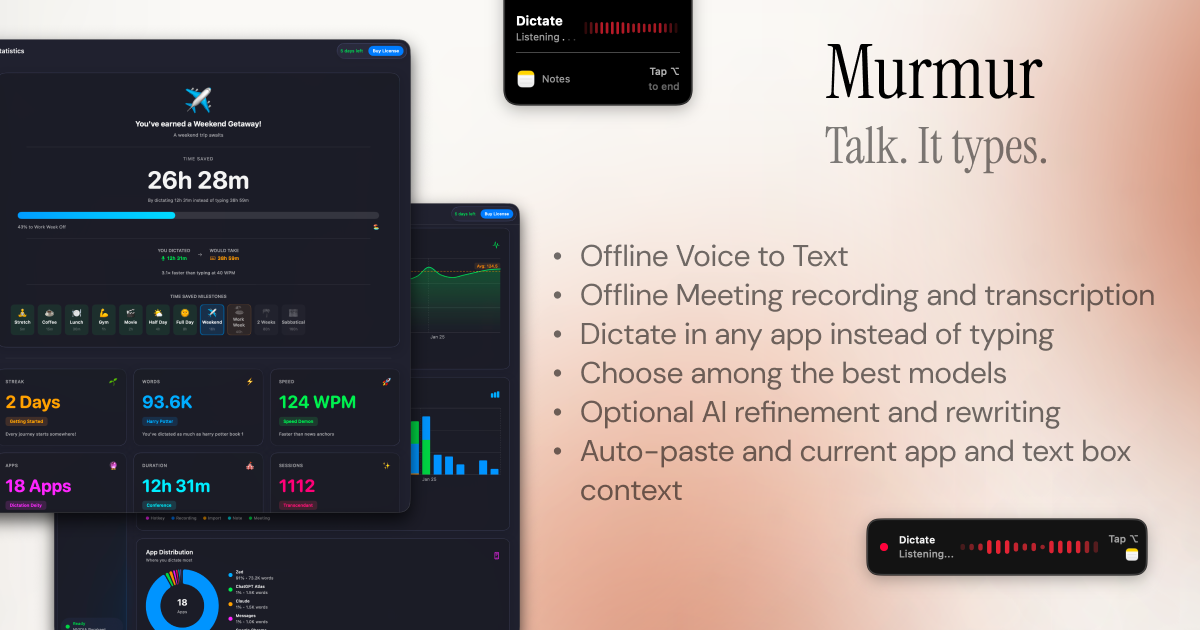
A built a hot-key triggered dictation app for Mac. I’ve dictated over 20 hours with it, and my work is so much more productive with it due to being able to give my agents a lot more context and instructions easily.
Not only that. It’s also a:
- meeting recorder with transcription and summary generation + speaker diarization.
- teleprompter with near-real-time transcription to auto scroll
- pick from a bunch of STT models
- add AI providers cloud + local ollama for spoken text refinement
And a lot more.
CLAUDE_CODE_NO_FLICKER=1 claude is a significant improvement!
Perhaps my most abstract yet confluent article about my thoughts on AI and where it's headed, yet.
Switch to Jottings! See why in the words of John Oliver.
It’s weirdly sweet that a stranger’s yawn can jump to you instantly.
Two people who share nothing but a moment. Mouth wide open, eyes squinted, a yawn passed along. Then they both just keep going about their days.
Rewatch #4: The Good Place is still a holy motherforking masterpiece.
The audiobook The Good Place and Philosophy: Everything is Forking Fine! by some of the same people who made the show is incredible, too!
Here are some of my thoughts about Cloudflare's Markdown for Agents and the impact it would have on accelerating the zero-click internet.
If you like this format of video, please give it a like and subscribe to Nihil Codes on YouTube.
Cloudflare launched Markdown for Agents a few days ago. Here's a follow up article about the zero-click internet and the impact CF's new feature would have on accelerating this eventuality.
I wrote something about the Zero-click internet a few weeks ago. Read it below.
Something dropping soon!
A block storage backed by the world’s internet-connected devices! One of those videos that makes Internet worthy each day!
Murmur is now live! Dictation all across your Mac. Local models as well as Cloud ones using your API Key. Optional Ai refinement to work like WisprFlow. All for a one-time purchase with lifetime updates included.
Borrowing from @murk1572: Technology connections talks about solar and then goes nuclear
I've been talking about how on-device ML models may be used by third party apps to profile users' data even when end-to-end encrypted since 2019.
I'd previously written two articles detailing how this may be done. I conducted experiments to show how efficient and silent this profiling could be. Read these on my blog.
Part 1: Encrypted, But Not Invisible: How Apps Could Use On-Device ML to Profile You
Part 2: On-Device LLMs & Your Encrypted Data: The Profiling Risk Amplified
In the light of the latest WhatsApp lawsuit, I revisited this. Read more below.
Part 3: The WhatsApp Lawsuit and a Tangent on What's Technically Possible
Debugging code is like being a detective in a crime movie where you're also the murderer.
Something new is brewing! Take a peek at the preview!
Hypnotrochoid
Something in the works!
Undeniable proof that LLMs have social anxiety just like humans.
/s
I'm recording the Jottings intro video! Stay tuned! 🚀
I'm making an intro video for Jottings!
Stay tuned!
ControlHub now has widgets on both home & lock screens! See your stats at a glance without opening the app! v1.3.0
/ralph-wiggum:ralph-loop combined with /speckit.implement is a game changer. Especially after launching claude with --dangerously-skip-permissions.
Use Speckit's specify, clarify, plan, and tasks to provide all required context and acceptance criteria for the story. Ensure the implementation plan uses well-parallelized sub-agent spawning as the execution mechanism.
The ralph-loop then drives execution, recursively enforcing the spec and iterating on the workflow until everything is dialed in and correct.
/ralph-loop best works for things like running tests and iteratively fixing bugs or build/compile issues.
Or just /ralph-loop in Claude Code.
/ralph-loop "<prompt>" --max-iterations <n> --completion-promise "<text>"🚀
while :; do cat prompt.md | claude -p --dangerously-skip-permissions; done
Works remarkably well when prompt contains proper boundary and output necessary conditions and it gives some information to the agent about storing memory in a file.
After some boring but fruitful reverse engineering, ControlHub now supports ControlD's Analytics 2.0. Finally!
Highly recommended: Chonak Rava Fry thali at Ramesh Restaurant, Anjuna, Goa.
In Barefoot, Goa, Akuri is the best start to the day and an even better precursor to a siesta.
My site has a fun new interactive banner to show off nihil.codes. Take a look :)
nihil.codes has a new skin! Completely redesigned with threejs. Take a look!
Sugar withdrawal is quite something.
Apple Music needs a Picture-in-Picture mode for Live Lyrics.
After all that networking wrangling, DynamoDB being down in us-east-1 gave me a minor-panic.
Update: AWS says there are issues with multiple services. There goes my morning's productivity streak!
Spent two tense days wrangling a complex Cloudflare–AWS networking setup. Multiple customer-owned hosted zones converging into a single SaaS domain with automated verification, certificate provisioning, and dynamic routing. Claude Code came through this morning. Impressed.
I've been thinking. Seating, in general, sucks! More thoughts will follow.
Do hyphens, en dashes, and em dashes pose a fundamentally contradictory challenge to monospace font designers?
It's genuinely good food when it doesn't allow you to be bothered by how shitty the place is.
— Rahul's (my brother) insightful yardstick.
Apple’s Spatial Scene does again what Live Photos did for photos: adds another dimension to memories.
Only gripe: mirrors break the illusion. Reflections stay flat, glitching like a game whose graphics engine is just slightly off.
Some movies fade once you “know.” The genius of Arrival is that rewatching it isn't redundancy. Every viewing becomes an act of homage that mirrors the film's own architecture.
Those who know, know.
The short story it is loosely based on—Story of Your Life, although quite different from the movie, is also worth a read.
AutoMix on iOS 26 Apple Music is surprisingly very good!