Tag: privacy

4 jots

Subscribe to this tag
RSS 2.0 https://jottings.vishalvshekkar.com/tags/privacy/feed.xml
Atom 1.0 https://jottings.vishalvshekkar.com/tags/privacy/atom.xml
JSON Feed https://jottings.vishalvshekkar.com/tags/privacy/feed.json
Vishal V. Shekkar
Vishal V. Shekkar I declare verified!
@vishalvshekkar
Sun, 16 Aug 2026 04:07:37 GMT

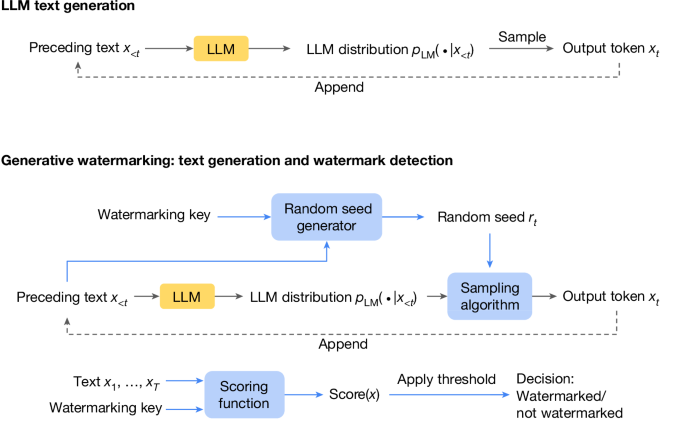
Anthropic uses SythID-Text approach for watermarking popularized by Google Deepmind, and tested within Gemini. This method uses tournament sampling to pick the next token from a possible set of tokens (size dependent on available entropy for that next token.)

SynthID like many other watermarking technique uses a pseudorandom key to run the tournament knockout on the highly-likely candidates for the next token.

In principle, generative text watermarking can be extended from just provenance detection ('this came from model E') to cryptographic fingerprinting ('this came from account AGHRS125') or even multi-bit attribution ('this encodes identifier Y').

Model providers may use different keys per account instead of one key across all generations. Possibly using a pseudo-random function that mixes the master key with a user identifier so they may generate it deterministically during detection/attribution.

Another, more novel way is to encode some identifying information as binary payload into the watermark itself. watermark payload = providerID | modelID | accountID | requestID

Just the way the plain watermark is encoded in the statistical manner determined by SynthID in the next-token available entropy space, that watermark itself could carry accountID and a lot more info. This way, any meaningful length of text generated by a model could have the signature of who prompted its generation.

This is an extremely powerful tool, which I'm sure, would be exploited to its depths in the near future.

Note: The SynthID paper itself doesn't get into personal attribution. But, there are other mechanisms built specifically with the objective of identification.
Vishal V. Shekkar
Vishal V. Shekkar I declare verified!
@vishalvshekkar
Sun, 16 Aug 2026 03:49:04 GMT

While I understand why watermarking is important to identify content originating from a generative model and establish provenance, it is yet another tool in that may be deployed in mass surveillance with ability to tie generated content to specific account/groups/geography.

As much as I hate AI slop, and the deeply disturbing side of generative AI like deepfakes and mass propaganda it can enable, a tool to fight that can also be used as a tool for also targeting individuals.

Vishal V. Shekkar
Vishal V. Shekkar I declare verified!
@vishalvshekkar
Wed, 11 Feb 2026 17:54:13 GMT

Something dropping soon!

A photo from a video shoot
Vishal V. Shekkar
Vishal V. Shekkar I declare verified!
@vishalvshekkar
Sat, 31 Jan 2026 06:27:04 GMT

I've been talking about how on-device ML models may be used by third party apps to profile users' data even when end-to-end encrypted since 2019.

I'd previously written two articles detailing how this may be done. I conducted experiments to show how efficient and silent this profiling could be. Read these on my blog.

Part 1: Encrypted, But Not Invisible: How Apps Could Use On-Device ML to Profile You

Part 2: On-Device LLMs & Your Encrypted Data: The Profiling Risk Amplified

In the light of the latest WhatsApp lawsuit, I revisited this. Read more below.

Part 3: The WhatsApp Lawsuit and a Tangent on What's Technically Possible