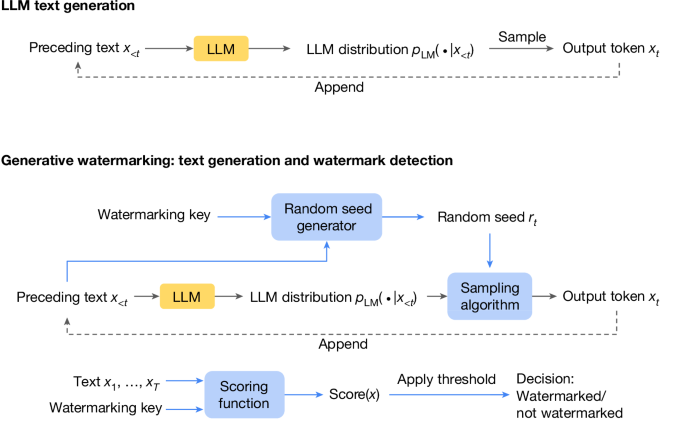
Anthropic uses SythID-Text approach for watermarking popularized by Google Deepmind, and tested w...

Anthropic uses SythID-Text approach for watermarking popularized by Google Deepmind, and tested within Gemini. This method uses tournament sampling to pick the next token from a possible set of tokens (size dependent on available entropy for that next token.)
SynthID like many other watermarking technique uses a pseudorandom key to run the tournament knockout on the highly-likely candidates for the next token.
In principle, generative text watermarking can be extended from just provenance detection ('this came from model E') to cryptographic fingerprinting ('this came from account AGHRS125') or even multi-bit attribution ('this encodes identifier Y').
Model providers may use different keys per account instead of one key across all generations. Possibly using a pseudo-random function that mixes the master key with a user identifier so they may generate it deterministically during detection/attribution.
Another, more novel way is to encode some identifying information as binary payload into the watermark itself. watermark payload = providerID | modelID | accountID | requestID
Just the way the plain watermark is encoded in the statistical manner determined by SynthID in the next-token available entropy space, that watermark itself could carry accountID and a lot more info. This way, any meaningful length of text generated by a model could have the signature of who prompted its generation.
This is an extremely powerful tool, which I'm sure, would be exploited to its depths in the near future.
Note: The SynthID paper itself doesn't get into personal attribution. But, there are other mechanisms built specifically with the objective of identification.